A rare ‘sweet spot’ for potential San Diego homebuyers. New housing study shows inventory is up and prices are down countywide

SAN DIEGO COUNTY, Calif. — This year could be a good year to start searching for a home in San Diego County, according to a new study from Zillow

The online housing website ranks San Diego County as the 17th-hottest market in the country, with home prices down from last year and inventory up. Last year, San Diego County ranked 19th among the hottest home markets.

San Diego tends to be San Diego Metro tends to be a relatively hot housing market,” said senior economist at Zillow, Dr. Orphe Divounguy. “San Diego’s housing market has cooled a little bit, right? Sellers have returned, but affordability challenges have kept buyers on the sidelines. As a result, housing inventory has increased, and the housing market has loosened slightly. That loosening of the housing market has led to prices actually falling. Home values declined by about 2.3% on a year-over-year basis in our latest housing market report.”

That means, according to Dr. Divounguy, buyers have more wiggle room when making an offer on a home. 

In their report, Zillow found that 26% of all listings in the San Diego metro area saw price cuts, allowing buyers to get their homes below the asking price. 

California homes for sale for $260K? Here’s where to find lowest prices

The group’s most recent report from Jan. 15 shows the statewide median home price was $850,680 in December, down 0.4% from $853,780 in November and lower than $861,020 from December 2024.

“California’s housing market closed out 2025 on solid footing, with both home sales and available inventory improving over the prior year,” Tamara Suminski, California Association of Realtors president, said in the Jan. 15 report.

As price growth slows and mortgage rates continue to drop, real estate experts say conditions are improving for potential homebuyers.

What to expect from the housing market in 2026—and the 10 major cities where prices could fall the most

The housing market has spent the past few years stuck with high prices and slow sales. But in 2026, conditions are expected to ease slightly for buyers, a shift Redfin describes as a “reset” year.

That reset is being driven by a growing supply of homes after years of limited inventory, which may push prices down in some markets next year.


Overall, home prices have mostly leveled off over the past two years, as new construction has picked up. And there are already signs the market is loosening: Homes are sitting on the market longer, negotiations are becoming more common, and builders are offering discounts in markets where the supply of newly constructed homes has increased, according to Realtor.com.

That doesn’t mean homes will suddenly become affordable nationwide. Median home prices are still too high for many buyers after rising by 25% since 2020, according to U.S. Census data. Thirty-year fixed mortgage rates are also expected to remain elevated above 6% in 2026, limiting how much relief buyers are likely to see.

Mortgage Rates Forecast For 2026: Experts Predict Whether Rates Will Keep Dropping

Mortgage rates spent much of 2025 parked in the upper-6% range, held in place by persistent inflation pressures and a cautious Federal Reserve. That began to shift late in the year as the Fed signaled it was ready to ease policy. Rates slipped ahead of the September 2025 rate cut, the first of the year, and then drifted lower again before the October meeting before continuing their gradual decline as markets anticipated further action.

At the close of its in December meeting, the final one of the year, the Fed delivered another 25-basis-point cut, bringing the federal-funds rate down to a range of 3.50% to 3.75%. It’s the third consecutive meeting with a rate reduction and a clear sign that policymakers believe inflation is moving sustainably toward their target.

Mortgage rates have softened alongside these moves, though not as dramatically as borrowers might hope. The average 30-year fixed mortgage rate recently ticked down to about 6.2%, slipping from the mid-6% range earlier ithis fall. While that’s still well above the unusually low rates seen a few years ago, it marks meaningful progress from the roughly 7.05% peak reached in January 2025. But as the Fed continues easing and bond market conditions stabilize, will mortgage rates see additional downward pressure? Here’s what experts say.

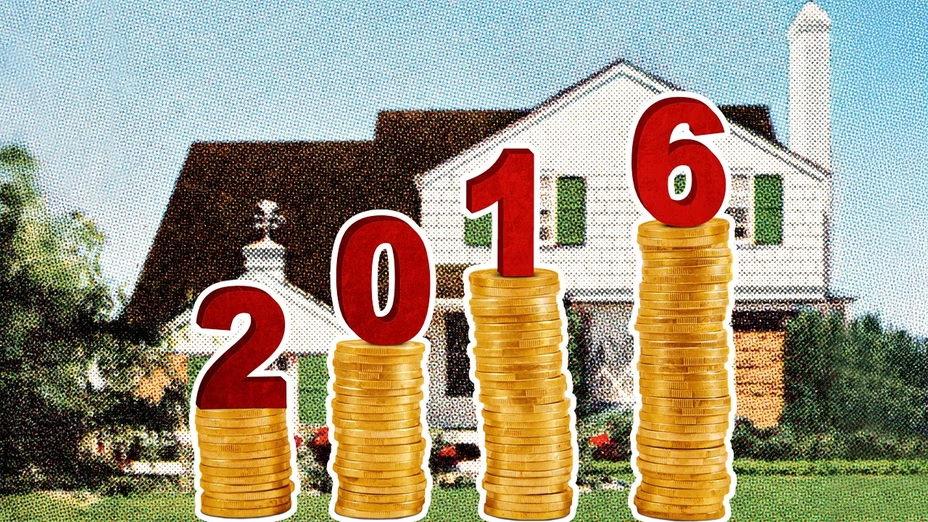
Here’s How the Housing Market Has Changed Over the Past 10 Years

Here’s the bad news: In 2016, the typical home cost just $233,800, which is nearly 80% lower than in 2025, when the median price registered at $414,400, according to NAR data. 

At the same time, there are roughly 470,000 fewer for-sale homes today than there were in 2016, when the national inventory reached 1.65 million properties. 

Looking at home sales, there were 5.54 million closings in 2016, compared to just 4.06 million last year, which represents a 1.39 million drop. 

The steep decline in sales should come as little surprise considering the surging borrowing costs, with mortgages rates climbing from 3.7% in 2016 to 6.6% in 2025, significantly eroding homebuying affordability for households

“Although the homeownership rate is higher today than in 2016, boosted by pandemic-era demand and historically low financing costs, entering the market remains a challenge for many households,” says Realtor.com Senior Economic Research Analyst Hannah Jones.

Against this backdrop of intensifying financial headwinds, the median age of the typical first-time homebuyer in the U.S. reached a record high of 40 last year, up from 32 in 2016.

“It comes down to affordability. Higher home prices, higher mortgage rates, and limited entry-level supply mean it takes longer to afford a first home,” says Evangelou. “These buyers aren’t opting out, but they are being pushed to buy later.”